Grove Park Nitrate Removal System

Click here to view the memo from Benner Township Water Authority (BTWA) that was distributed to all customers of the Grove Park Water System regarding the planned installation of a nitrate removal system on the Grove Park Well. Although the solution is not immediate (permits and quotes pending), we wanted everyone to be aware if the plans in case any homeowner was planning on modifying their household water system to address nitrate or hardness. If that’s your situation, you may want to wait or call our office at 814-355-4778 to see how the plans of BTWA will impact yours.

Thank you,

Benner Township Water Authority

High Water Usage

Did you recently get a letter stating that your water usage was higher than normal? There could be a logical reason for that and you may be aware of the increased use. However, if you are unsure why your home water usage has increased, here are a list of possible reasons that your water usage was higher:

Watering your garden
Sprinkler systems
Putting water in your pool
Extra people in the household taking showers and doing laundry
If none of these pertain to your situation there could be other reasons that your usage was high. Is your water softener running continuously? If your water softener is stuck in regeneration mode it is running water continuously thus spiking your water usage.

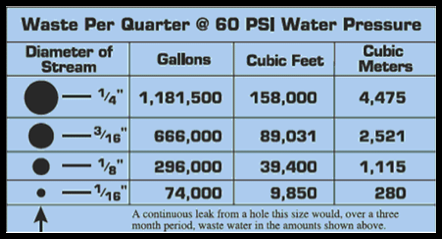
Another reason your water usage could be high is a leak – i.e. a leaking faucet or toilet. At times your toilet valve may malfunction and allow water to continue to flow down the drain. To test the toilet, place several drops of food coloring – red, green, blue – into the tank in the back. After 15 minutes look in the bowl, if you see the food coloring your toilet is leaking.

The best way to check for leaks is to turn all the water off in your home and wait a few minutes. Then go to your water meter and check to see if the dial is moving. If the dial is still moving even after the water is off then there is a leak and you should call your plumber for further assistance.

If you still aren’t sure please don’t hesitate to contact our Authority office.

Water Usage Facts

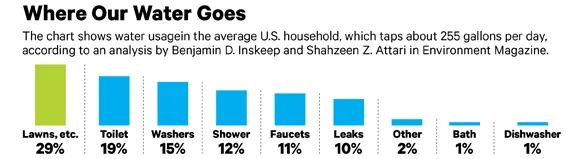
Water usage facts that you probably did not know in regards to how much your daily tasks are actually using.

Older toilets use 3.5 gallons per flush
Dishwashers use 7 gallons per cycle
Washing dishes by hand uses roughly 20 gallons
It takes about 30 gallons to fill the bath tub, taking a shower uses less water
Swimming pools naturally lose about 1,000 gallons per month due to evaporation

Other Related Links:

5 Facts about Water Use In your Home by Allstate

Residential Water Usage Facts by Katy News

Indoor Water Use At Home by Grace Communications Foundation

Statistics and Facts by EPA

100 Amazing Water Facts You Should Know by Seametrics

Drought Watch Declaration

The Pennsylvania Department of Environmental Protection (PA DEP) has issued a drought watch across multiple counties including Centre. The declaration is in response to declining groundwater levels, and persistent precipitation deficits.

Residents are asked to reduce water use by 5%-10% through voluntary conservation measures.

Ways to conserve water at home:

  • Run water only when necessary. Don’t let the faucet run while brushing your teeth or shaving. Shorten the time you let the water run to warm up before showering.
  • Run the dishwasher and washing machine less often, and only with full loads.
  • Water your garden in the cooler evening or morning hours, and direct the water to the ground at the base of the plant, so you don’t waste water through evaporation.
  • Water your lawn only if necessary. Apply no more than 1 inch of water per week (use an empty can to determine how long it takes to water 1 inch). Avoid watering on windy and hot days. This pattern will encourage healthier, deeper grass roots. Over-watering is wasteful, encourages fungal growth and disease, and results in shallow, compacted root systems that are more susceptible to drought.
  • When mowing your lawn, set the blades to 2-3 inches high. Longer grass shades the soil, improving moisture retention. It also grows thicker and develops a deeper root system, so it can better survive drought.
  • Check for and repair household leaks. For example, a leaking toilet can waste up to 200 gallons of water daily.
  • Sweep your sidewalk, deck, or driveway instead of hosing it off.
  • Replace older appliances with high-efficiency, front-loading models that use about 30 percent less water and 40-50 percent less energy.
  • Install low-flow plumbing fixtures and aerators on faucets.
  • Set up a rain barrel to be ready to repurpose rain when it does fall.

For more information please use the Drought Information Center on PA DEP’s website : https://www.dep.pa.gov/business/water/planningconservation/drought/pages/default.aspx